Friday Morning at Pusara Abadi
It had been more than a year. To tell you the truth, I cannot remember if I had made a trip to the Choa Chu Kang Muslim Cemetery in the whole of 2023. I spent the week before collating the burial plots of those who I had wanted to pay my respects to. At least four of them were graves that had been exhumed and re-interred into new plots.
I made the arduous 30-minute journey with my mother and brother. I spent a large part of the journey in conversation with my brother, as we both recounted our days in school and National Service. I have fond memories of my time serving the nation. I shared with my brother, as I share with you now, that the formative years of my research actually took place during those two and a half years.
During Ramadhan of 2005, in place of having lunch, my Encik would drive us out to Masjid Pusara Aman for zuhur. We had thirty minutes or so each day to kill before that, so I requested that he bring me to my grandmother’s grave. I remember where it was very well. Unlike some other graves deep within the cemetery complex, it was easy to locate. If I wanted to, I could even walk to it from the mosque. I just needed to take a right from the rear exit of the mosque that faces the cemetery, turn at the bend that goes downslope, and then keep walking down a straight path for another five minutes or so until I see the Garden of Remembrance on my right. It was a walk that I would take for the next decade until her grave was exhumed sometime in 2013.
Not content with visiting just one grave that day in 2005, I went on looking for a new one each day. When I reached home, I’d ask my mother when a particular relative had passed away. My mother, with the photographic memory that she is blessed with, would provide me with the information and I’d go looking for the grave the next day. My Encik, probably amused by my efforts, agreeably drove me to wherever I needed to go.
Even till this day, I recall the feeling of solitude amidst the thousands of graves in Pusara Aman, the older of the two burial sites at the Choa Chu Kang Muslim Cemetery. I would walk up and down rows of graves, my feet at times stepping on unsteady ground covered by grass that grew up to my knees, worried if there was a snake hidden somewhere within. Unlike the newer graves at Pusara Abadi, these graves were not separated by concrete burial vaults. They were dug, by hand, often following the contours of the land. If not overgrown grass, then layers of slippery green moss would make navigating between narrow rows of graves highly challenging, if not outright dangerous.
In the years that followed, I would continue visiting some of these graves. There was something serene about the cemetery. Somewhat forgotten, if not abandoned, nature would often reclaim its place after a while. I witnessed huge trees growing out of graves giving shelter to others. I listened to the songs of birds I wouldn’t hear elsewhere. I believe all these graves have now been completely exhumed and the area redeveloped.
On one of our subsequent drives within Pusara Abadi, I noticed a mound with what looked like rows and rows of neatly arranged headstones. My Encik stopped the car. I climbed up the slopes with burning curiosity and realised these headstones, not much taller than my ankles, marked the graves of tens of thousands reinterred from Bidadari Cemetery. If I have clear memories of Pusara Aman and Pusara Abadi, then sadly I have absolutely no recollection of Bidadari Cemetery. By the time I climbed up that slope, I was about three years too late. I often wonder how it would have been like if I had been born just half a generation earlier.
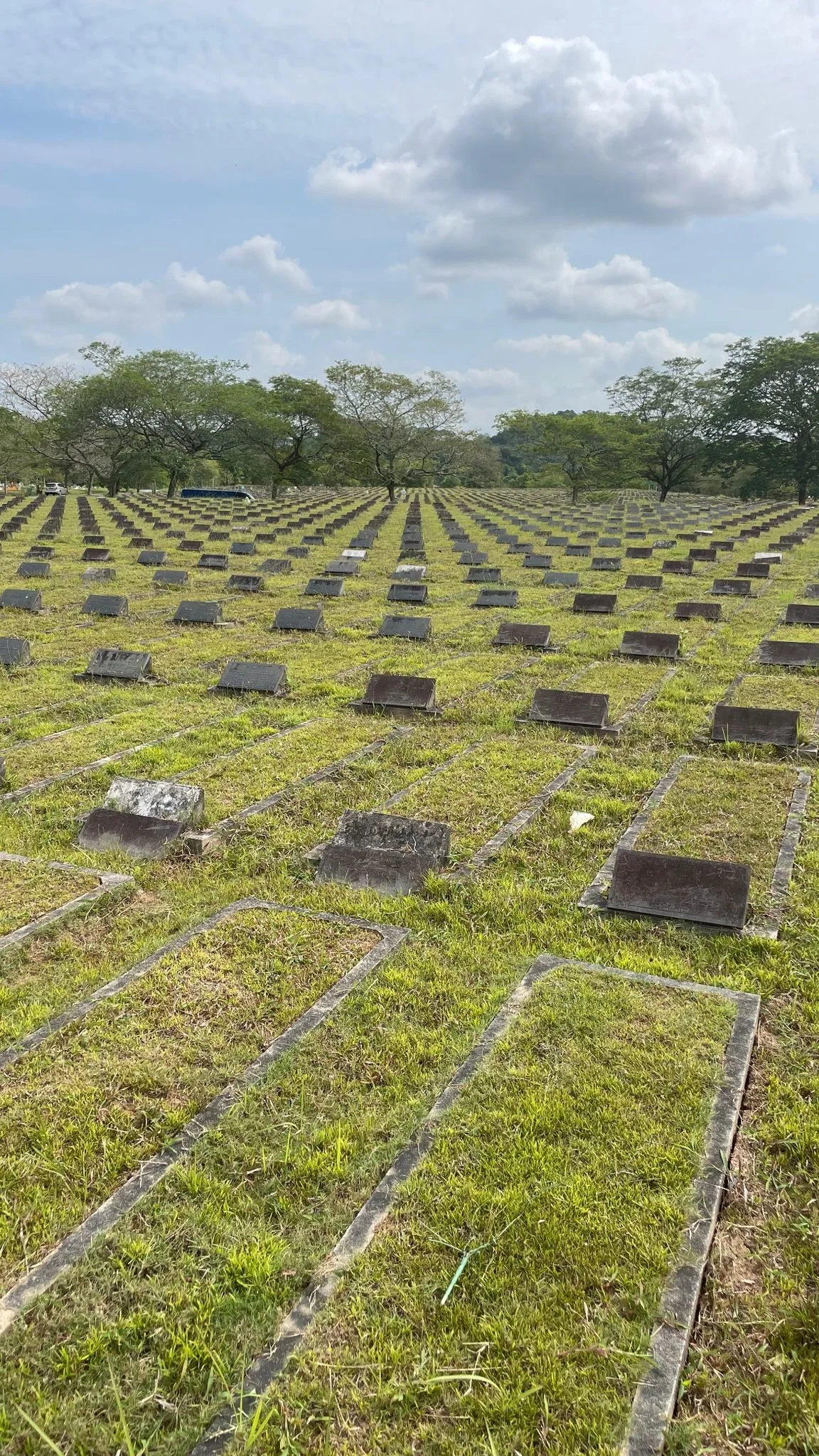
This is a section Choa Chu Kang Cemetery where about 147,000 graves from Bidadari Muslim Cemetery are now re-interred. Many of them were unclaimed and remain unidentified.
On Friday morning when we reached the cemetery, the weather was fine. The clouds gave us shade from the otherwise piercing morning sun. It was a quick visit. Within two hours, we had visited the graves and paid our respects to those who had departed. The cemetery looks and feels very different now. A lot has changed with the ongoing exhumation and re-interment. Whole blocks of the the newer graves at Pusara Abadi have been completely exhumed, leaving behind overgrown grass, dead trees, and pieces of broken wood and concrete. At least the birds are still singing.