My Attempt at Cooking Something Pakistani
I should probably make a disclaimer. The title photo you clicked on does not belong to me. It is a stock photo chosen for illustration purposes. I didn’t cook that nor did I photograph it. What I eventually made was far worse.
So my mom gave me a kilogram of fresh mutton that she received for qurban. And for the third time ever, I attempted to cook mutton. The first two times were disastrous enough to put me off ever trying to cook mutton. I could never figure out how to get it soft enough for safe human consumption.
After doing some research, I felt courageous enough to attempt it a third time. Don’t boil the meat at a high flame. Keep it to a simmer. Leave it for an hour. You know, things like that.
Then came the question of what dish I should cook. Since I was a young boy, my mom would typically cook either of these dishes upon receiving qurban meat - sup daging (mutton soup) or dalcha. Neither of these dishes, I am aware, are Pakistani. But they are staple dishes for South Asian families in Singapore. Dalcha for example, is often consumed with briyani. People in Singapore are accustomed to having dalcha with briyani, so much so that if dine in at Bismillah Briyani at Dunlop Street, there is a sign inside the restaurant informing you that the restaurant serves its briyani with raita and not dalcha. In fact, it goes a step further, warning you not to ask for said dalcha! I always found that hilarious. Apparently, if you google it up, you find that dalcha originates from Hyderabad. It makes sense I suppose, since the briyani served in Singapore is often identified as Hyderabadi briyani.
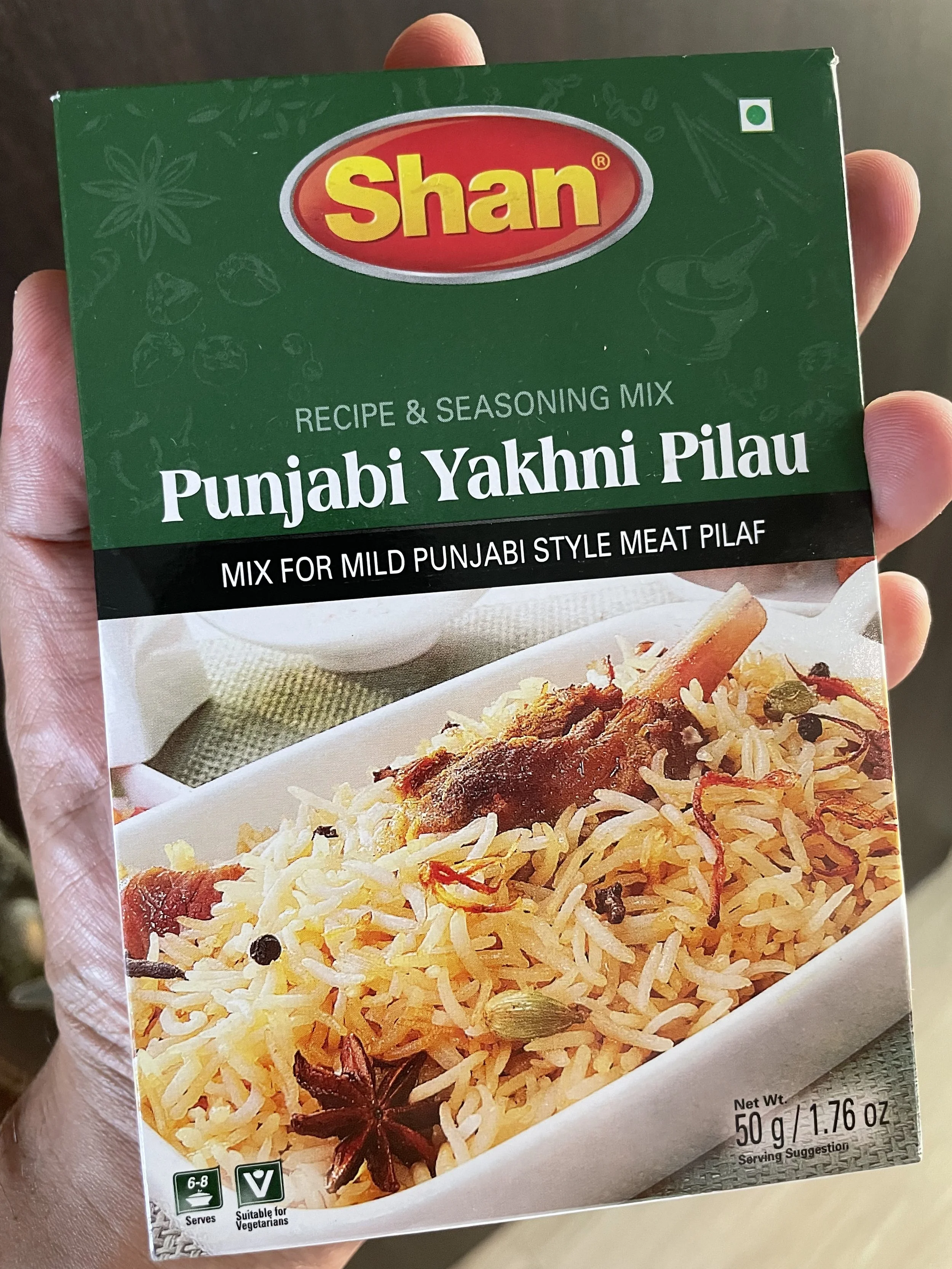
Expectation.
In my attempt to honour my Pakistani heritage and rekindle my love for cooking, I asked around for Pakistani mutton dishes that would be easy to attempt. Anything cooked with Shan seemed to be the unanimous answer. So after a quick trip to Mustafa, I settled for a packet of Shan’s Punjabi Yakhni Pilau. It looked appetising and fairly easy to cook. The instructions at the back of the packaging says you can cook it in five easy steps! I’ll summarise them further:
Boil the mutton with the packet of Shan spices and ginger/garlic paste. When cooked, separate the mutton from the stock. Fry onions in (an insane amount of) ghee (more on that later!) then add in meat and stock. Add in rice. Cook for twenty minutes.
According to one website, Yakhni Pilau “is an indigenous dish that involves practised technique and meticulously measured ingredients. The word is derived from the Persian word Yakhni, which means the stock of broth. It is generally believed that the popular dish originated in the middle east.”
So yesterday, I thawed out the mutton and opened the packet of Shan. It was the day to cook Punjabi Yakhni Pilau. If you’ve read this far, it probably shows you’re invested to know what the outcome was. Well, it was another disaster!
The first two steps were fairly alright. I made sure to keep the flame low as I cooked the mutton for 1 hour and 15 minutes. The aroma of mutton mixed with spices was indeed appetising. And at this stage of cooking, it felt encouraging.
The instructions that kept me thinking far longer than it should though was this:
Then remove the meat from the stock. Measure the stock and make it exactly equal to 6 full tea cups.
I swear, I think the person who wrote this for Shan was probably longing for his/her cup of chai as it was being commissioned. I mean, please just inform me much that amount is in litres ! It doesn’t help that the previous step tells the reader to use 7 cups of water - just normal cups mind you, not tea cups.
But still that wasn’t going to deter me yet. The aroma of chopped onions frying, nay, bathing in ghee was simply incomparable to anything my kitchen has witnessed in recent times. Up to that point, everything seemed good. But in a span of 10 minutes, things would change drastically. In the course of cooking today, I made three fatal mistakes:
The first was using the recommended amount of 1.5 cups of ghee. Again, perhaps I should have used cute little tiny tea cups. I actually emptied out an entire tub of ghee. 400 grams. I’ve never used more than three tablespoons of ghee for cooking. I should have realised, this was some kind of madness!
The second was not paying attention when I was frying the onions. You know how it is. 10 minutes of attending to your onions - nothing happens. 30 seconds looking away from it - your onions turn dark brown! Urgh! It’s like these onions conspire against you to ruin your dishes.
The third - amidst the panic of my onions turning dark brown, I added in the stock, meat and rice quickly and allowed it to boil (as suggested in the instructions) but then I forgot to lower the flame after closing the lid. It’s a rookie mistake, I know now. You are supposed to cook rice on a low flame.
The result? Undercooked and yet extremely greasy pilau with a strong taste of ghee and burnt onions!
Perhaps the best summary of today’s effort was when my helper asked, “Sir, nasi ini dimasak dengan kicap?” (Sir, is this rice cooked with soy sauce?) It would have made me feel better if she was actually sarcastic. (She wasn’t of course.)
Excuse me while I cry my eyes out.
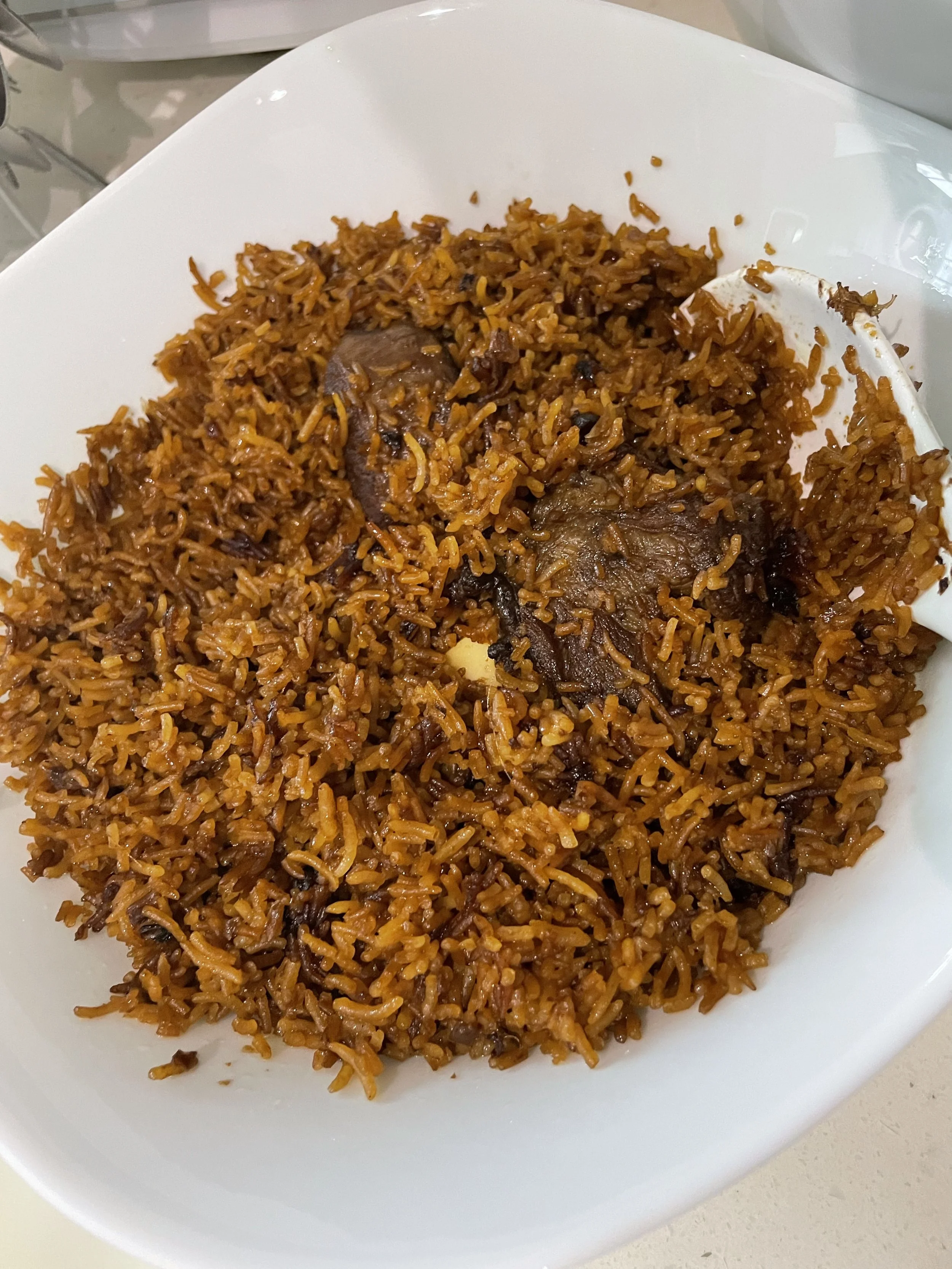
Reality.
PS. Thank you to the kind people who reached out to me, giving helpful tips and encouragement for cooking.