Some Forgotten Links with Masjid Abdul Gafoor
After my afternoon tea session at Campbell Lane and a brief sojourn to the Indian Heritage Center, I proceeded to Masjid Abdul Gafoor at Dunlop Street for Asar. Stepping in Masjid Abdul Gafoor, I always find myself in awe of the mosque’s facade and general architecture. My words couldn’t possibly do justice to its magnificence but fortunately, the description I found on National Heritage Board’s website borders on the poetic:
Blending Saracenic and Neoclassical elements together, the design of Abdul Gafoor Mosque is beautifully eclectic. Among the Saracenic features are the exquisite cinquefoil arches with heavy mouldings around the verandahs of the prayer hall. These are juxtaposed with the numerous Neoclassical Corinthian and Doric pilasters. Crescent moon and star motifs – symbols widely associated with the Islamic faith – embellish the exterior walls. Minaret-like features line the roof parapet, each crowned with a miniature ogee-shaped (onion-shaped) dome and a crescent moon.
Above the main entrance is one of the mosque's most outstanding features: an elaborately decorated sunburst flanked by two fluted pilasters and topped by an ogee-shaped pediment. The intricate sunburst design is adorned with the names of the 25 most prominent Islamic prophets – from Adam to Muhammad – in elegant Arabic calligraphy.
The grand cupola rises as an octagonal structure on the roof and has eight windows with colourful glass panels. Capping the cupola is a large ogee-shaped dome, which is then topped by a crescent moon and a star on its pinnacle. Inside the mosque, four large cluster columns and semi-circular arches supporting the structure of the cupola add grandeur to the prayer hall. Various Arabic calligraphy panels further contribute to the religious atmosphere within the mosque.
Source: https://www.roots.gov.sg/places/places-landing/Places/national-monuments/abdul-gafoor-mosque
There is another reason why I feel connected to Masjid Abdul Gafoor. Having done a lot of research on the early Pakistani diaspora in Singapore, I find Masjid Abdul Gafoor a point of convergence in a number of narratives by interviewees. One such case is that of Nenek Chand, who I wrote about in my thesis:
Born before 1920, Nenek Chand is the oldest of my interviewees and to my knowledge, the oldest surviving second-generation Pakistani in Singapore. Her father, an accomplished and decorated policeman, had arrived in Singapore during the first wave of migration. He married the daughter of the Imam of a mosque in Dunlop Street. During the interview I asked her what language she spoke to her father in, to which replied with laughter, “Semua cakap Melayu. Kita tak tahu cakap Mengali pun!” (All of us spoke Malay. No one knew to speak the native language!)
Nenek Chand grew up in Dunlop Street at the house of her maternal grandfather, Imam Abdul Qadir. Like Nenek Chand’s father, he had originated from British India as well - although it is unclear what his ethno-linguistic origin was. Nenek Chand would have been a little girl when the Hindu and Mohammedan Endowment Board took over the management of the mosque in 1927 and elected a management committee to run the mosque. Two prominent individuals who must have been familiar with Nenek Chand’s father were among those elected. They were Syed Gulab Shah and Syed Qudrat Shah.
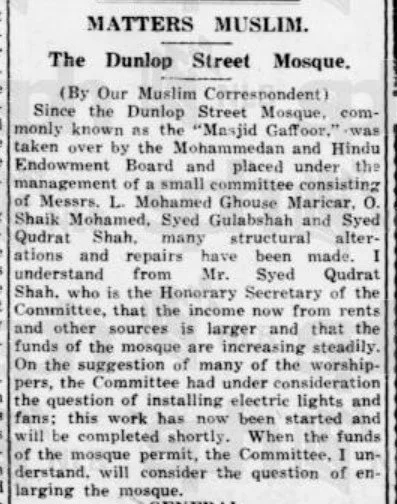
Source: The Singapore Free Press and Mercantile Advertiser (1884-1942), 22 September 1928.
Syed Gulab Shah was a migrant from Hazara District of the Northwest Frontier Province, British India. He was a highly respected member of the Muslim community in Singapore during the Interwar years. He led a long, meaningful life and passed away in 1956. (I have written an extensive research piece about Syed Gulab Shah on The Karyawan which you can find online.)
Syed Qudrat Shah on the other hand, was a migrant from Lahore, Punjab, British India. And unlike Syed Gulab Shah, he passed away somewhat prematurely in 1929, just two years after being appointed Honorary Secretary of Masjid Abdul Gafoor. Nonetheless, he was a prominent member of the Punjabi Muslim community in Singapore.
In February 1926, Syed Qudrat Shah was appointed one of the four representatives of the Punjabi Muslim community in the raising of funds for Sultan Mosque. He was for many years the Honorary Secretary of the local Anjuman Islam establishment, having been instrumental in its founding in 1921. He frequently submitted articles for the organisation’s publication, The Muslim and was its Honorary Editor.
From what I understand, Syed Qudrat Shah came to Singapore before the First World War and like many individuals from Punjab and the Northwest Frontier Province of British India, he joined the Straits Settlements Police as a constable. He later was appointed Hindustani interpreter at the Civil District Court and served for more than 15 years until his untimely death in July 1929.
Photo credit: Tripadvisor